
PPR-GF-PPR Pipe: Thermal Expansion, Layer Design and Co-Extrusion Control
A glass-fibre-reinforced PP-R middle layer can reduce the linear thermal movement of a multilayer hot-water pipe, but the reduction is not a universal percentage. It depends on the declared compound, fibre content and orientation, layer ratio, pipe geometry and product qualification. This guide separates a useful engineering calculation from the claims that must be verified on the finished piping system.
1. What PPR-GF-PPR Means
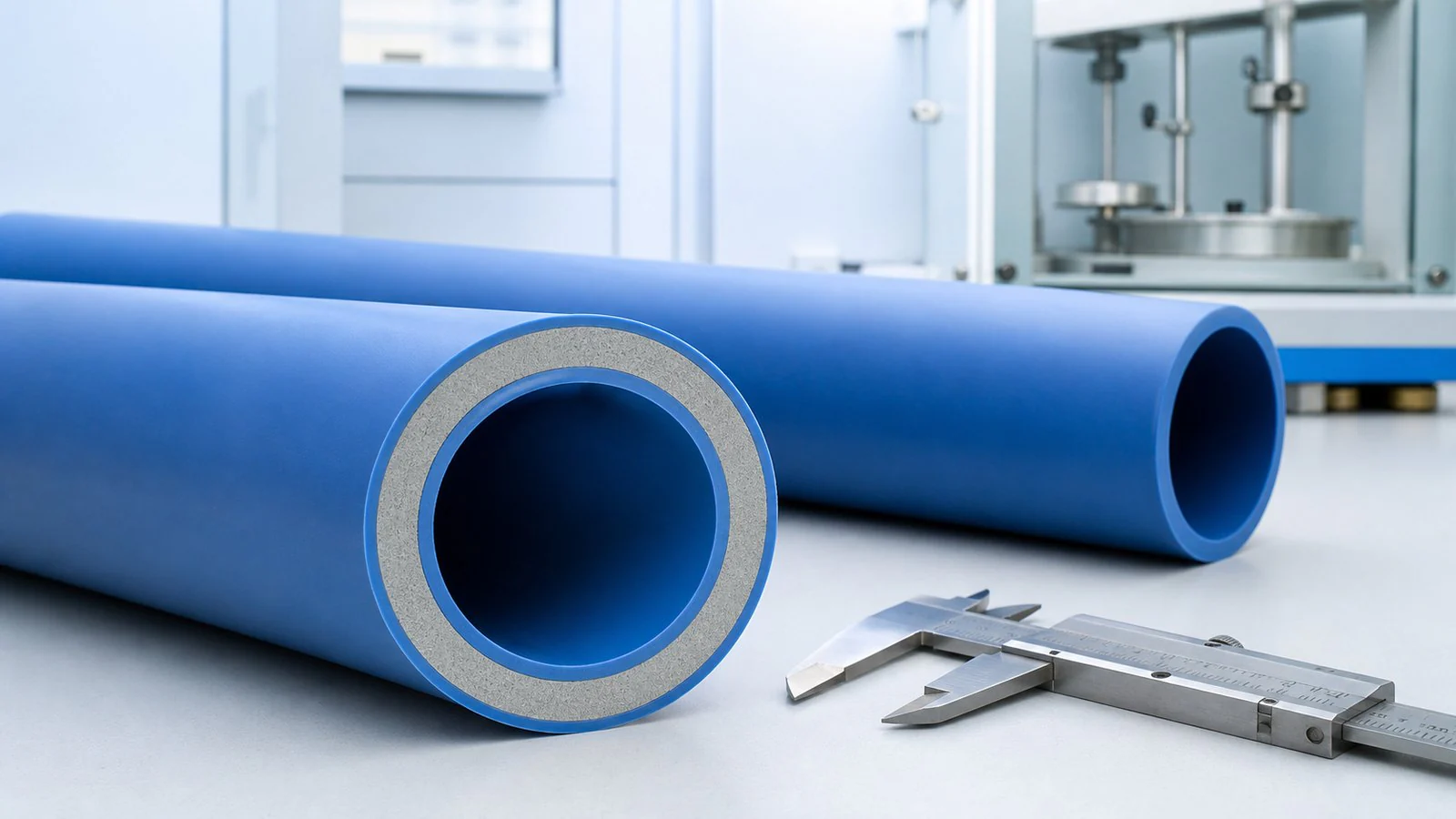
PPR-GF-PPR commonly describes a pipe with a PP-R inner layer, a glass-fibre-filled PP-R middle layer and a PP-R outer layer. The middle layer increases axial stiffness and restrains part of the thermal strain that would otherwise occur in homogeneous PP-R. The surface layers preserve a PP-R waterway and a PP-R fusion surface when that construction is part of the approved system.
| Layer | Primary function | Production concern |
|---|---|---|
| Inner PP-R | Water-contact surface and hydraulic bore | Clean material handling, smooth surface and minimum declared thickness |
| PP-R/GF core | Reduced thermal movement and increased axial stiffness | Qualified compound, uniform dispersion and stable layer ratio |
| Outer PP-R | External surface and fusion interface | Surface quality, colour and sufficient fusion-layer thickness |
Do not infer pressure class from the layer name. Glass-fibre reinforcement may improve stiffness, but allowable pressure and temperature service must come from the qualified pipe-and-fitting system, not from fibre content alone.
2. Thermal Expansion: Use the Declared Coefficient
Linear thermal movement is estimated from ΔL = α × L × ΔT, where α is the pipe manufacturer's declared linear thermal expansion coefficient, L is the installed length and ΔT is the relevant pipe-temperature change.
For a representative calculation only, compare homogeneous PP-R at 0.15 mm/(m·K) with a composite pipe declared at 0.05 mm/(m·K). A 10 m run exposed to a 40 K change would have calculated movements of 60 mm and 20 mm respectively.
| Illustrative input | Homogeneous PP-R example | Composite example |
|---|---|---|
| Declared α | 0.15 mm/(m·K) | 0.05 mm/(m·K) |
| Length | 10 m | 10 m |
| Temperature change | 40 K | 40 K |
| Calculated movement | 60 mm | 20 mm |
The numerical reduction in this example is 67%, but it is not a universal product value. Design calculations must use the coefficient published for the selected pipe and the temperature range relevant to the installation.
3. Why the Effective Expansion Coefficient Varies
- Compound formulation: fibre type, content, coupling system and PP-R matrix influence stiffness and thermal response.
- Fibre orientation: extrusion aligns many short fibres in the machine direction; orientation and breakage affect axial restraint.
- Layer ratio: a thin reinforced core cannot provide the same effect as a larger qualified structural layer.
- Temperature and conditioning: polymer modulus changes with temperature, time and moisture exposure.
- Manufacturing consistency: eccentric layers, unstable output or poor interlayer bonding reduce confidence in the declared performance.
4. Co-Extrusion Line Arrangement
An A/B/A construction can often be produced with two melt streams: the main PP-R extruder supplies the inner and outer skins through a purpose-designed multilayer die, while a co-extruder supplies the reinforced B layer. A three-extruder arrangement may be selected when the two PP-R skins require independent materials, colours or output control.
Material feeding
Feed qualified PP-R and pre-compounded PP-R/GF pellets through controlled loaders or gravimetric dosing appropriate to the formulation.
Separate plasticizing
Match each screw, drive and temperature profile to its melt stream; do not assume identical settings for neat and filled PP-R.
Multilayer distribution
Balance annular flow so the reinforced layer remains continuous and concentric without disturbing the fusion skins.
Sizing and cooling
Coordinate vacuum, cooling and haul-off with total wall mass, line speed and the stiffness of the composite melt.
5. Process-Control Priorities
- Use pre-compounded reinforced pellets unless the project includes a separately engineered compounding process.
- Track the mass output of both melt streams and verify layer thickness around the full circumference.
- Control residence time and melt temperature to avoid PP degradation and unstable colour.
- Confirm interlayer integrity after production; visual concentricity alone does not demonstrate long-term performance.
- Retain production samples for dimensional, thermal-cycling and hydrostatic testing under the governing conformity plan.
6. Standards and Product Qualification
ISO 15874 addresses polypropylene piping systems for hot and cold water installations under defined application classes, design pressures and temperatures. ISO 21003 is a reference product-standard series for multilayer piping systems. Which route applies to a particular PPR-GF-PPR construction must be confirmed with the product specification and certification body.
Hydrostatic strength should be demonstrated on pipe specimens using the applicable product requirements and methods such as ISO 1167-1. Thermal cycling, impact, opacity, organoleptic or drinking-water requirements may also apply. A generic website statement such as “PN25” or “50-year life” is not a substitute for this evidence.
7. Fusion and Installation Implications
When the approved product has PP-R fusion skins, socket fusion may use familiar PP-R equipment. However, heating time, insertion depth, fitting compatibility and preparation must follow the pipe-system manufacturer's instructions. Reduced thermal movement can simplify support design, but it does not eliminate the need to calculate anchors, guides, clips and expansion accommodation for the actual installation.
8. Frequently Asked Questions
Does every PPR-GF-PPR pipe reduce expansion by 67%?
No. That figure follows from comparing 0.15 with 0.05 mm/(m·K). Use the selected manufacturer's declared coefficient and qualified construction.
Does glass fibre automatically increase the pressure rating?
No. Stiffness and pressure endurance are different design questions. Pressure-temperature classification requires testing of the complete pipe and joint system.
Can the same line produce single-layer PP-R?
Often yes, if the main extruder, tooling and downstream capacity are suitable and the changeover procedure has been validated. Tooling configuration is project-specific.
Configure a PPR Multilayer Pipe Line
Provide the pipe drawing, qualified compounds, layer ratio, diameter range, output target and governing product specification so the extruders, die and downstream equipment can be matched as one process.
Review the PPR Pipe Extrusion Line