
Plastic Pipe Extrusion Line: Complete Selection Guide
A plastic pipe extrusion line is not selected by pipe material alone. Finished diameter, wall structure, dimensional tolerance, line speed, cooling demand and final handling method must be evaluated together. This guide compares PE, rigid PVC, PPR, flexible hose and specialty tube production without treating one machine recipe as universal.
1. What a Complete Plastic Pipe Extrusion Line Includes
A pipe extrusion line converts a qualified thermoplastic compound into continuous pipe or tube. Material is fed and plasticized in the extruder, distributed through an annular die, sized and cooled, pulled at a controlled speed, and then cut, stacked or coiled. Each stage affects the next: extruder output must be matched to die capacity, cooling length and haul-off speed.
- Material preparation and feeding — loading, drying, blending or gravimetric dosing as required by the polymer and formulation.
- Plasticizing and melt delivery — the extruder melts, mixes and pressurizes the compound within its stable processing window.
- Pipe forming — the die and tooling establish the annular melt flow and initial wall distribution.
- Calibration and cooling — the calibrator establishes outside geometry while staged cooling removes heat without excessive distortion.
- Traction and finishing — haul-off speed coordinates the line; cutting, stacking or coiling matches the delivery format.
Control principle: wall mass is primarily a balance between melt output and line speed. Outside diameter is established by tooling and calibration. Cooling capacity must be sufficient for pipe mass, wall thickness and melt temperature. These relationships are connected, but they are not interchangeable.
2. Material and Process Map
| Product family | Typical feed form | Common extrusion approach | Important selection issue |
|---|---|---|---|
| PE / HDPE pressure and utility pipe | Pellets | Material-specific single screw extruder | Melt homogeneity, cooling capacity and dimensional verification |
| Rigid PVC / UPVC pipe | Prepared dry blend or compound | Counter-rotating conical or parallel twin screw is common for dry blend | Low-shear thermal control, formulation preparation and socket requirements |
| PPR pressure pipe | Pellets | Single screw extrusion, with co-extruders when required | Stable wall distribution, color/layer structure and controlled cooling |
| Flexible PVC hose | Compound, often granulated | Commonly single screw; line arrangement depends on reinforcement | Plasticizer formulation, braiding or helix reinforcement and tension control |
| PA / TPU / PMMA / PC / ABS tube | Pellets | Material-specific precision single screw extrusion | Drying, residence time, surface quality and precise downstream control |
The table describes common industrial approaches, not mandatory recipes. Resin supplier guidance, the applicable pipe specification and a documented production trial take priority over generic settings.
3. PE and HDPE Pipe Extrusion Lines
PE pipe lines use a single screw extruder optimized for the intended polyethylene grade and output range. The die, calibrator and cooling system are selected around pipe OD, wall thickness, line speed and the required dimensional stability. Small pipe may be coiled; larger pipe is normally cut and handled in straight lengths.
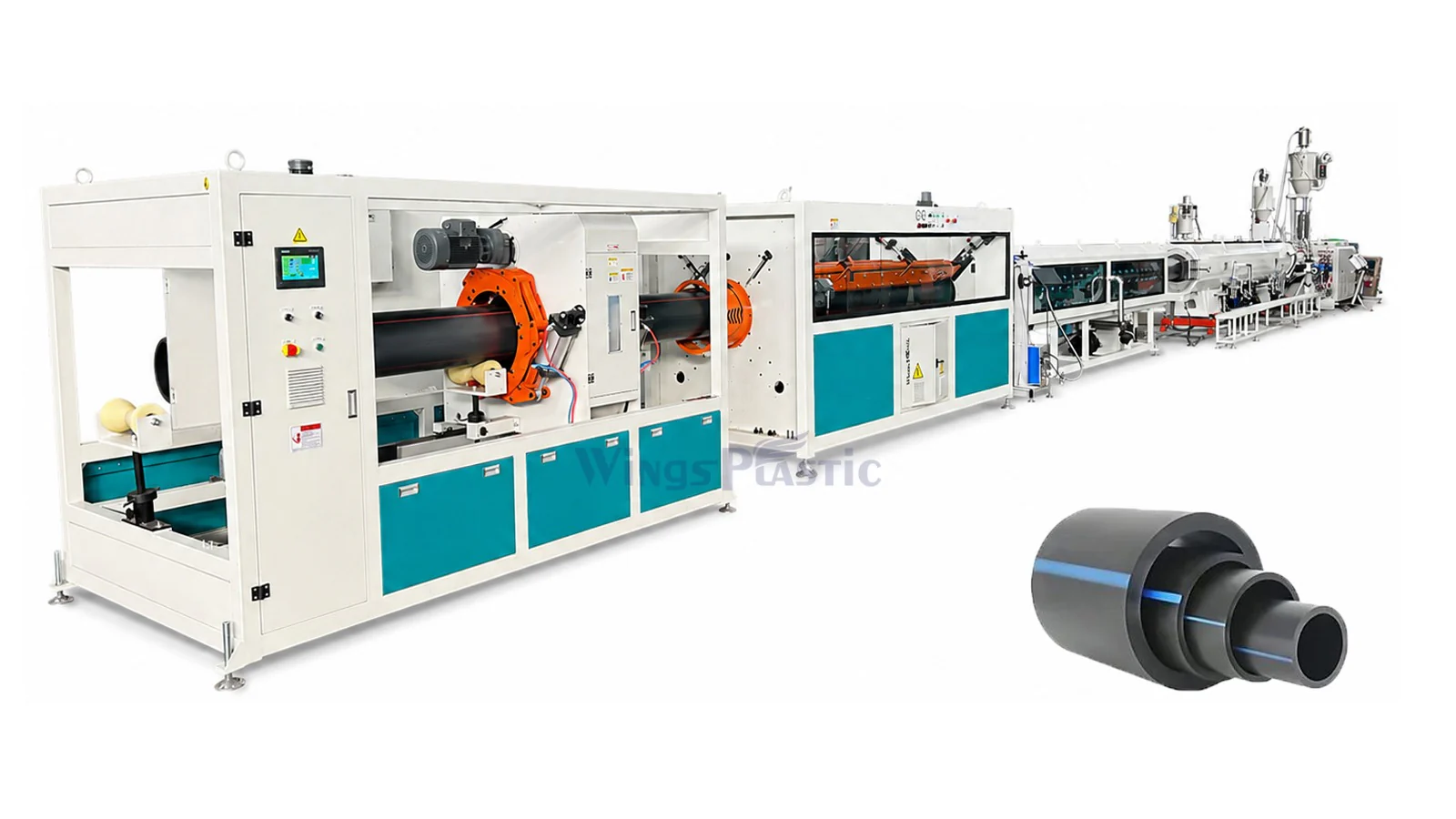
Questions to resolve before quotation
- Which resin grade and governing product standard will be used?
- What OD range, SDR or minimum wall thickness, and target output are required?
- Is the pipe single-layer, striped, or multilayer?
- Will the finished product be coiled or supplied in straight lengths?
- What water temperature, flow and plant utilities are available for cooling?
4. Rigid PVC Pipe and Flexible PVC Hose Lines
Rigid PVC dry blend is heat sensitive and is commonly processed with a counter-rotating conical or parallel twin screw extruder. A hot/cold mixing system may prepare the dry blend before extrusion. Tooling, vacuum calibration, cooling, haul-off and cutting are then selected for the pipe range; drainage and conduit projects may also require socket belling.
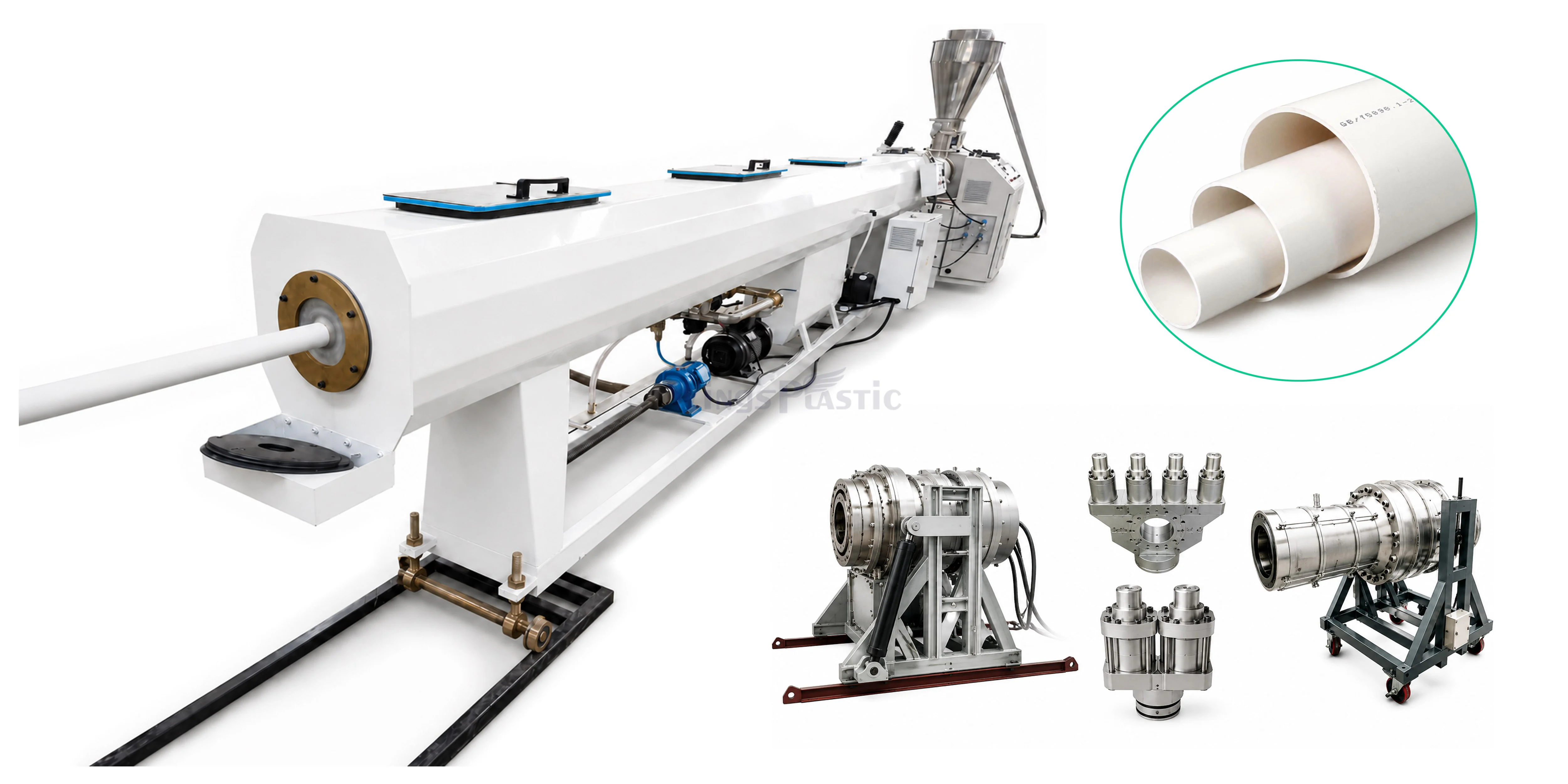
Flexible PVC hose should be evaluated separately. Compounded flexible PVC is often processed with single screw extruders, while fiber braid, steel wire or rigid spiral reinforcement introduces additional forming stages between inner and outer layers. Reinforcement pitch, tension and adhesion therefore become line-control variables.
Avoid a common specification error: “PVC” does not identify one universal line. Rigid UPVC pipe, transparent single-layer hose, fiber-braided hose, steel-wire hose and spiral suction hose have different extrusion and downstream requirements.
5. PPR Pipe Extrusion Lines
PPR pressure pipe is usually produced on a single screw line. The equipment can be configured for a homogeneous wall, longitudinal color marking, or a specified multilayer structure. Additional extruders and a compatible multilayer die are required when separate materials or functional layers must be combined.
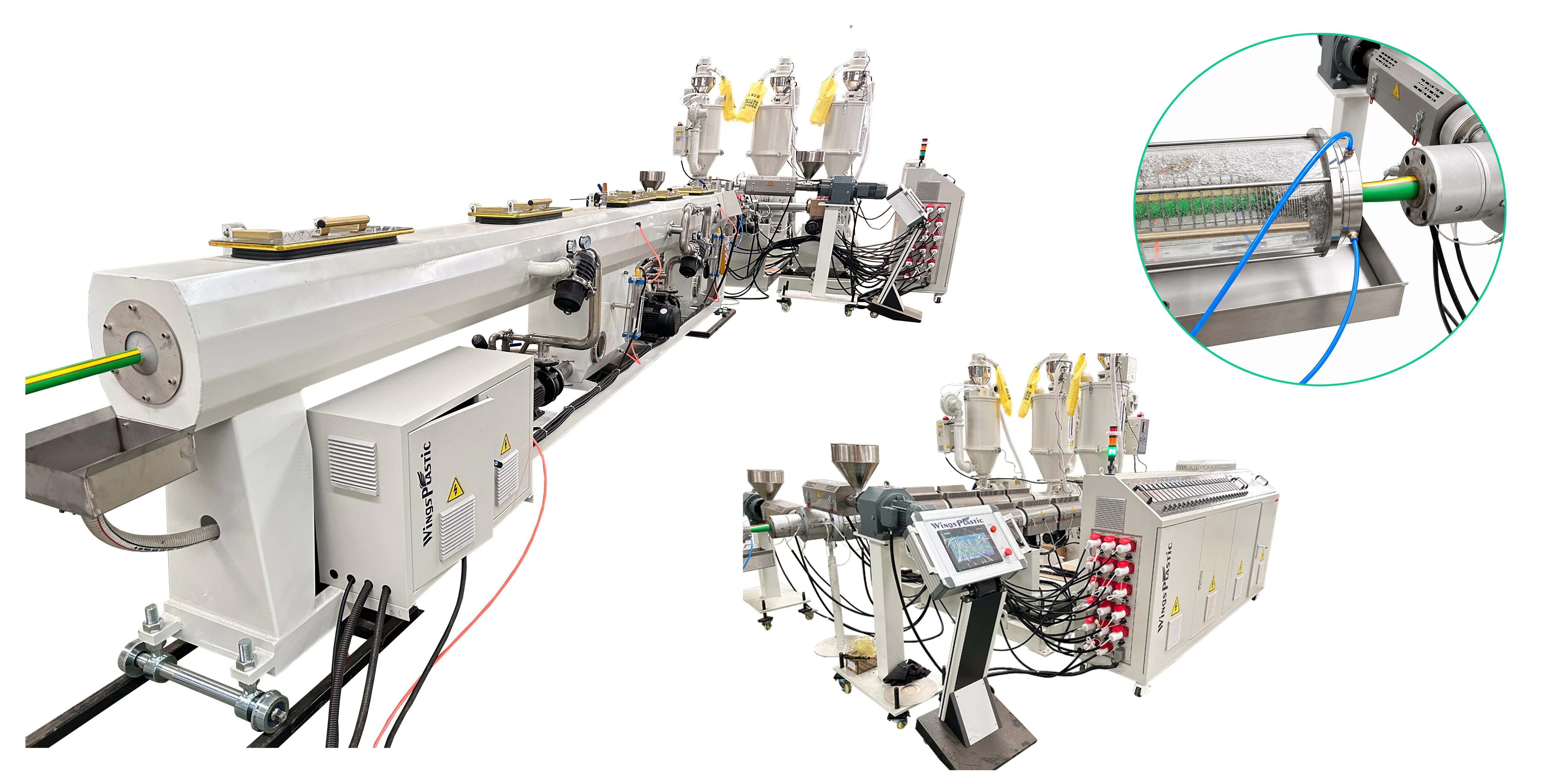
Layer ratios and reinforcement claims must not be assumed from a generic machine description. They need to be defined by the approved pipe design, compound supplier data and compliance testing.
6. PA, TPU, PMMA, PC and ABS Tube Lines
Specialty polymers are normally processed on compact, material-specific single screw lines with precise tooling and downstream control. Many PA, TPU, PMMA and PC grades are moisture sensitive, so resin drying and protected material handling can be as important as barrel temperature. The accepted drying condition must come from the resin supplier rather than a universal website value.
- PA nylon tube: focus on qualified resin drying, melt stability, tight OD control and suitable coiling or cutting.
- TPU tube: control moisture, surface quality, haul-off stability and winding tension.
- PMMA / PC transparent tube: prioritize clean material handling, drying, residence-time control and optical surface quality.
- ABS pipe or profile tube: match screw, die, calibration and cooling to the grade and finished geometry.
7. Core Line Components and Their Interfaces
| Component | Primary job | What must be matched |
|---|---|---|
| Extruder | Prepare and deliver stable melt | Polymer, output, screw design, drive and thermal window |
| Die head and tooling | Distribute annular flow | Material, OD range, wall structure and layer count |
| Calibration and cooling | Establish geometry and remove heat | Pipe mass, line speed, wall thickness and water system |
| Haul-off and finishing | Control speed and delivery format | Diameter, rigidity, surface protection, cut length or coil size |
| Auxiliary systems | Prepare material or add a process stage | Drying, dosing, mixing, reinforcement, marking and scrap plan |
8. Single-Layer, Striped and Multilayer Pipe
A single-layer pipe normally uses one main extruder. A longitudinal identification stripe uses a small co-extruder and compatible die passage. Multilayer pipe uses additional melt streams and a purpose-designed feedblock or multilayer die. The downstream line may be shared only when its sizing, cooling, traction and handling capacity remains suitable for the new construction.
Using recycled material in a layer is not automatically acceptable. Permitted material, layer position, minimum thickness, pressure classification and conformity testing are governed by the applicable product standard and customer specification.
9. A Four-Step Selection Method
Define the finished pipe
Confirm polymer, grade, standard, OD range, wall or SDR, layer structure, tolerances and end use.
Set production targets
State required kg/h and m/min, operating schedule, accepted changeover time and delivery format.
Match the complete process
Balance extruder and die capacity with calibration, cooling, traction, cutting, coiling and utilities.
Verify before acceptance
Agree on raw material, tooling, test pipe, inspection method, factory trial and acceptance criteria.
10. Commercial and Project Factors
Machine price alone does not define the useful cost of a line. Diameter range, output, tooling count, cooling length, automation, drive brands, safety scope, material preparation, printing, inspection, packing, installation and commissioning all affect the final project.
A comparable quotation should identify what is included, excluded and assumed. Provide at least the following:
- pipe drawing or sample, OD range and wall construction;
- polymer grade, formulation responsibility and applicable standard;
- target output and preferred cut length or coil format;
- factory voltage, frequency, water conditions and compressed-air availability;
- workshop layout, installation scope and required operator training;
- factory acceptance test material and dimensional acceptance criteria.
11. Frequently Asked Questions
Can one extrusion line make every type of plastic pipe?
No. A line may cover a defined size range and related products, but different polymers can require different screws, feeding, drying, dies, calibration and downstream equipment. Rigid PVC and PE should not be treated as interchangeable processes.
Can one line make several pipe sizes?
Usually yes, within the machine and downstream design range. Size changes typically require matching die tooling and calibrators plus revised operating settings. The permitted range must be confirmed in the technical proposal.
How should output be compared?
Compare output using the same polymer grade, pipe size, wall thickness, quality criteria and utility conditions. A maximum extruder figure alone does not prove stable finished-pipe production.
What should be included in a factory acceptance trial?
Define the resin, formulation, tooling, run duration, target rate, dimensional checks, surface criteria and documentation before the trial. Project-specific acceptance criteria should be agreed in writing.
Need a Line Configuration for Your Pipe?
Send the material grade, pipe drawing, diameter range, wall structure, target output and delivery format. The engineering discussion can then start from the finished product instead of a generic machine model.
Discuss Your Project